
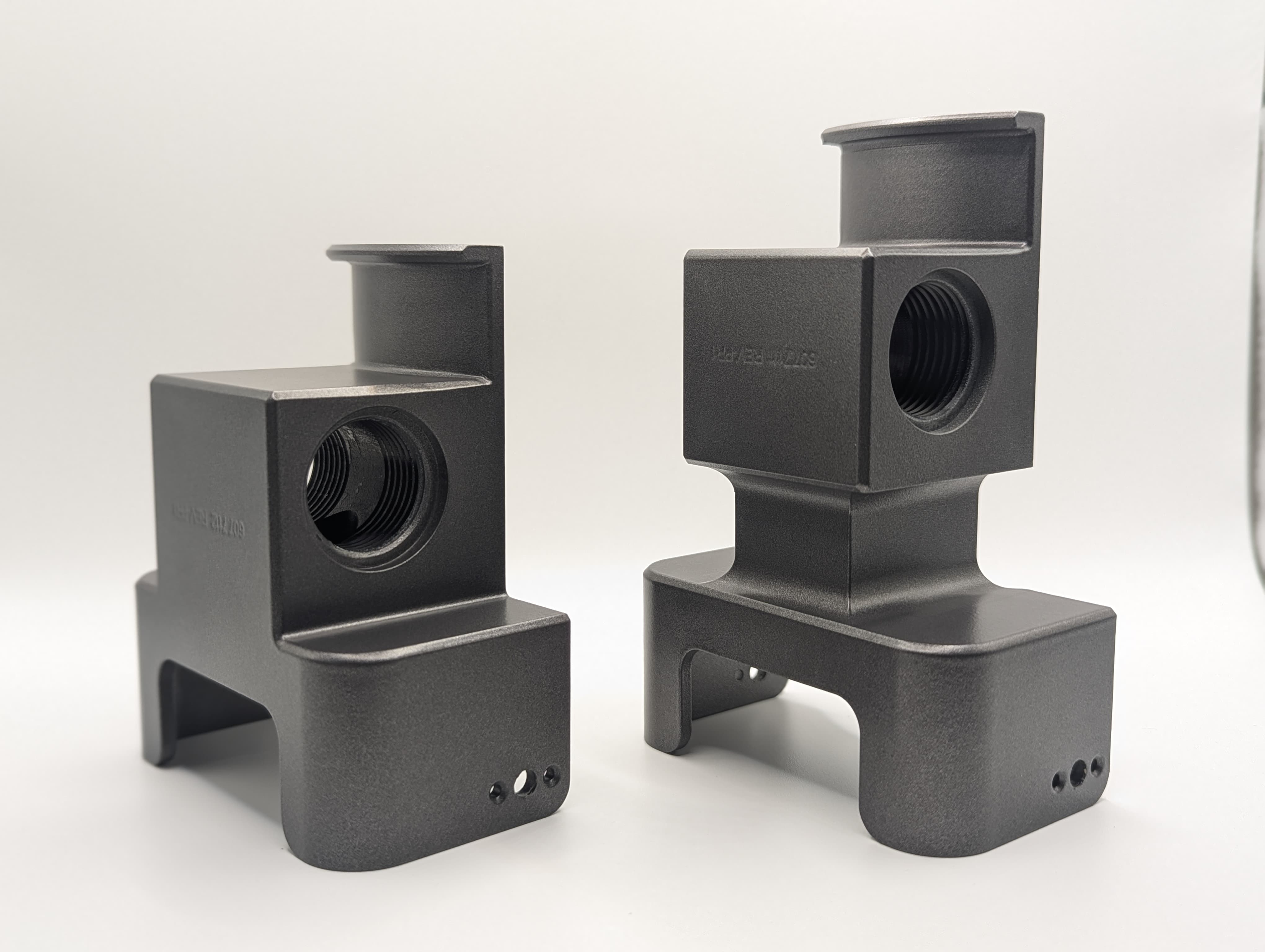
Five-axis CNC machining has become a buzzword in precision manufacturing. But it is not always the right answer. Understanding when 5-axis capability genuinely adds value — and when 3-axis machining does the job just fine — can save you money and lead time without sacrificing quality.
How 5-Axis Machining Works
A 5-axis CNC machine moves a cutting tool (or the workpiece) along five axes simultaneously: the three linear axes (X, Y, Z) plus two rotational axes (typically A and C, or B and C). This allows the tool to approach the workpiece from virtually any angle in a single setup.
Contrast this with a 3-axis machine, where the tool moves only in X, Y, and Z. To machine features on multiple faces of a part, the operator must stop the machine, reposition the workpiece in the fixture, re-indicate, and resume cutting. Each repositioning introduces potential for error and adds setup time.
When 5-Axis Makes a Real Difference
1. Complex Contoured Surfaces
Parts with compound curves, blended surfaces, or organic shapes — common in turbine blades, impellers, and aerodynamic components — are natural candidates for 5-axis. The simultaneous multi-axis motion allows the tool to maintain optimal contact angle with the surface, producing better surface finish and more accurate geometry than indexed approaches.
2. Features on Multiple Faces
If your part has holes, pockets, or features on three or more faces, 5-axis machining can complete them in one setup. Fewer setups mean better positional accuracy between features, because you eliminate the error introduced each time the part is repositioned.
3. Deep Cavities and Undercuts
The ability to tilt the tool allows access to features that would be impossible or impractical on a 3-axis machine. Deep, narrow pockets can be reached with shorter, more rigid tools — reducing vibration and improving surface finish.
4. Reducing Total Lead Time
For complex parts that would require four or five setups on a 3-axis machine, 5-axis machining can compress this into one or two setups. The programming time is longer, but total cycle time — including setup, machining, and inspection — is often shorter.
When 3-Axis Is the Better Choice
Not every part benefits from 5-axis capability. Consider staying with 3-axis when:
- Simple prismatic geometry: Flat surfaces, standard pockets, and holes on one or two faces are efficiently handled by 3-axis machines.
- High-volume production: For simpler parts in large quantities, 3-axis machines often have faster cycle times and lower hourly rates.
- Cost sensitivity: 5-axis machine time carries a premium. If the geometry does not require it, you are paying for capability you do not need.
The Hybrid Approach
At Tru-Tech Precision, we often use a combination. Rough machining on a 3-axis mill to remove material quickly, then finish machining on 5-axis for the features that demand it. This approach balances cost and capability — you get the precision of 5-axis where it matters without paying the premium for every operation.
Our engineering team evaluates every project to recommend the most efficient manufacturing approach. Sometimes that means 5-axis. Sometimes 3-axis is the right call. The goal is always the best combination of quality, cost, and delivery for your specific part.
Making the Decision
If you are unsure whether your part needs 5-axis machining, send us your drawings. Our engineering team provides complimentary DFM reviews and will recommend the most efficient manufacturing approach for your specific requirements. Get in touch to discuss your next project.